Quick Navigation
The 5 Best Spotting Scopes for Birdwatching
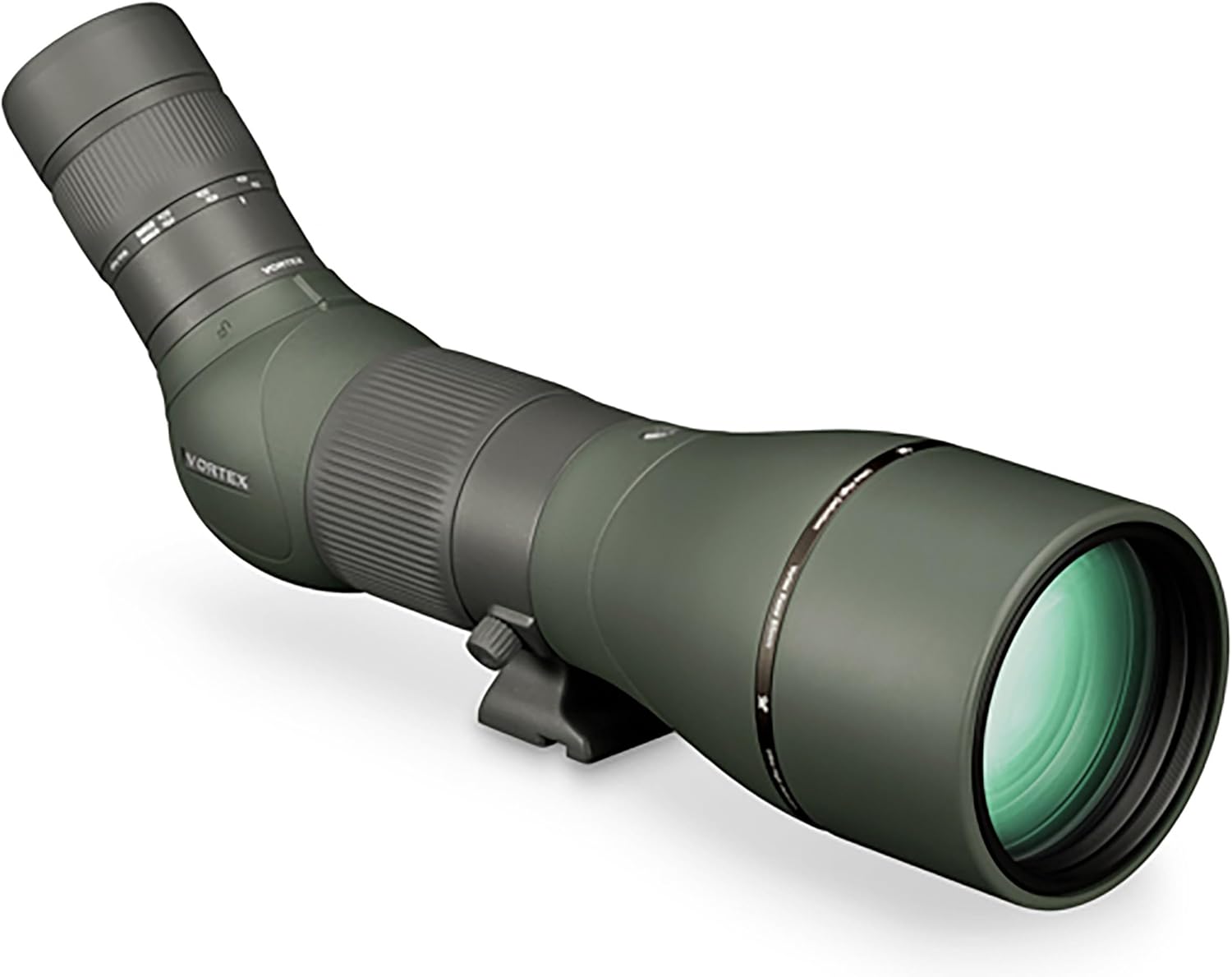
The Razor HD is the standard against which mid-range spotting scopes are measured. Vortex's APO (apochromatic) extra-low dispersion glass eliminates secondary chromatic aberration — the color fringing that makes a distant Snowy Plover's dark bill look fringed with purple in cheaper scopes. At 27x on the low end, the image is bright enough to use in poor coastal morning light; at 60x, it resolves the white trailing edge on a distant tern's wing. The angled 85mm body sits lower on a tripod than a straight scope at the same height, which reduces wind wobble on exposed headlands and sea-watch points. If you're buying one scope that will last 15 years of serious use, this is the entry point. Below $1,000 you are making meaningful optical compromises; above this price the improvements are real but incremental.
- +APO ED glass eliminates secondary chromatic aberration — no color fringing on difficult subjects
- +Zoom range (27–60x) covers both scanning and positive identification in one eyepiece
- +Argon purging and angled body are the right choices for exposed coastal and wetland use
- +Unconditional lifetime warranty — Vortex repairs or replaces, no questions asked
- −At 1,755g body weight, requires a sturdy tripod — a flimsy tripod will waste the optics
- −~$1,100 is a significant commitment; birders who primarily use binoculars may find a scope underused
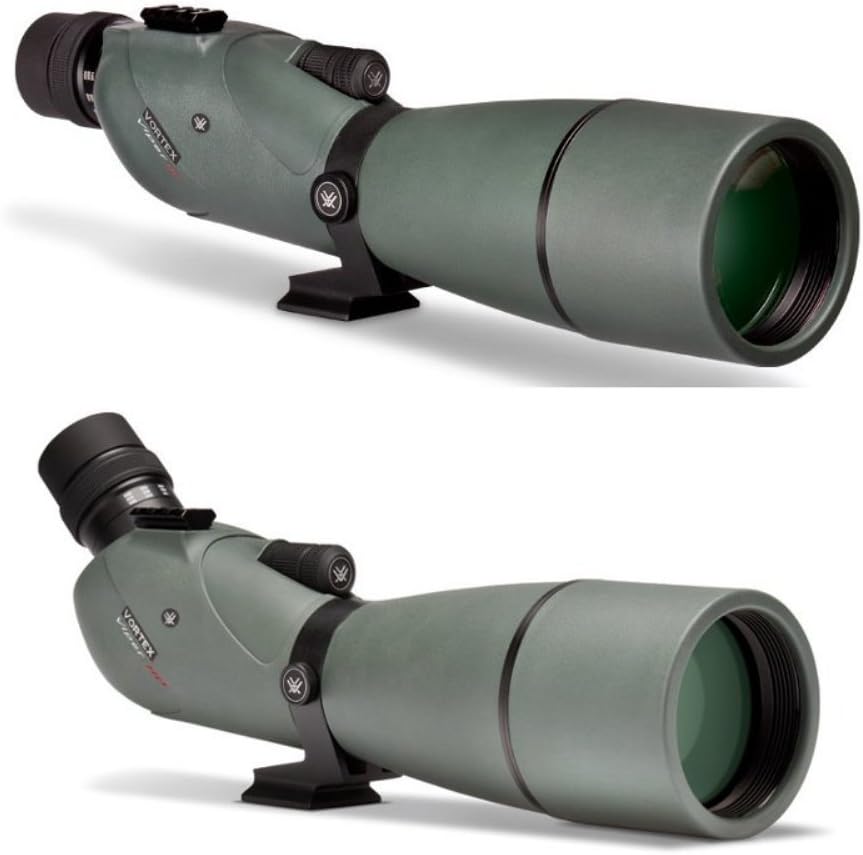
The Viper HD is the most common answer to "what spotting scope should I buy first?" — and it earns that position. At around $580, you get ED glass, argon purging, and Vortex's lifetime warranty in an 80mm package that's notably lighter than the Razor HD. The 80mm objective collects slightly less light than 85mm but the difference is visible only in the most demanding pre-dawn conditions. The 20x low end is a wider starting point than the Razor's 27x, making it easier to locate birds during scanning before zooming in for identification work. The optical quality drop relative to the Razor is real — primarily in edge sharpness and color accuracy at 50x+ — but most birders won't hit the Viper's ceiling until they're consistently at mudflat or hawk watch vigils where identification in marginal conditions matters.
- +ED glass at ~$580 — the optical sweet spot for serious birding without a premium cost
- +20x starting magnification makes scanning and finding birds easier than higher-minimum zoom scopes
- +Argon purging — same internal gas protection as the Razor HD at half the price
- +At 1,358g, appreciably lighter than the Razor — matters on long walks to a watch point
- −Edge sharpness and color accuracy degrade faster than the Razor at 50–60x magnification
- −80mm objective collects slightly less light than 85mm — visible in true pre-dawn conditions
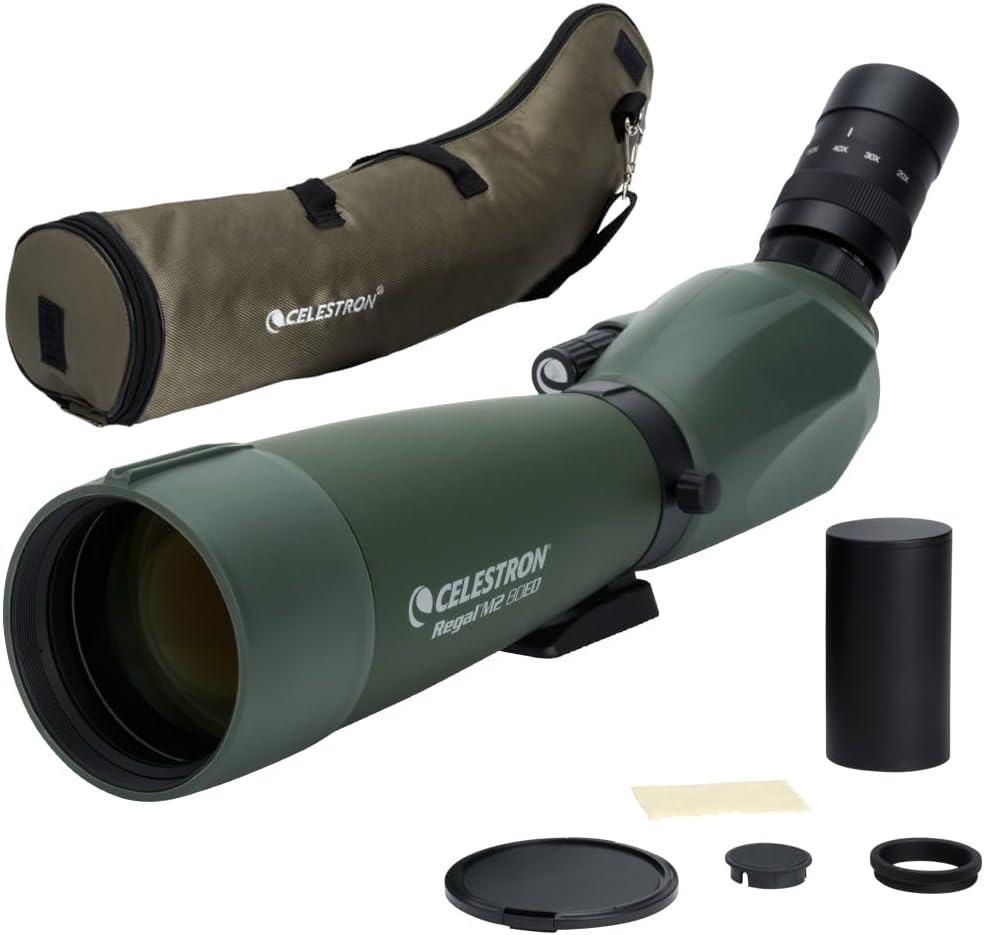
The Regal M2 is the best answer to "I need a proper spotting scope but cannot spend $500." ED glass under $280 is rare; Celestron delivers it here in an 80mm angled body with a dual-speed focuser — a feature usually reserved for $600+ scopes. The dual-speed focuser (coarse and fine adjustment) matters during long-range identification work where a single rough focus knob causes you to overshoot constantly. The optical quality is clearly below the Vortex Viper HD in high-magnification detail and color rendering — but it pulls ahead of non-ED scopes in the same price range by a meaningful margin. Main limitation is the 2-year warranty (vs. Vortex's lifetime) and a focus knob that some users find slightly stiff straight out of the box.
- +ED glass under $280 — the best optics per dollar in the budget scope class
- +Dual-speed focuser is a practical advantage borrowed from telescope design
- +Angled 80mm body is the right configuration for general birding
- +Genuine optical improvement over non-ED scopes at the same price
- −Color accuracy and edge sharpness fall behind the Vortex Viper HD at 50x+
- −Focus knob is stiffer than Vortex equivalents — loosens with use but can frustrate initially
- −2-year warranty is a meaningful gap from Vortex's unconditional lifetime coverage
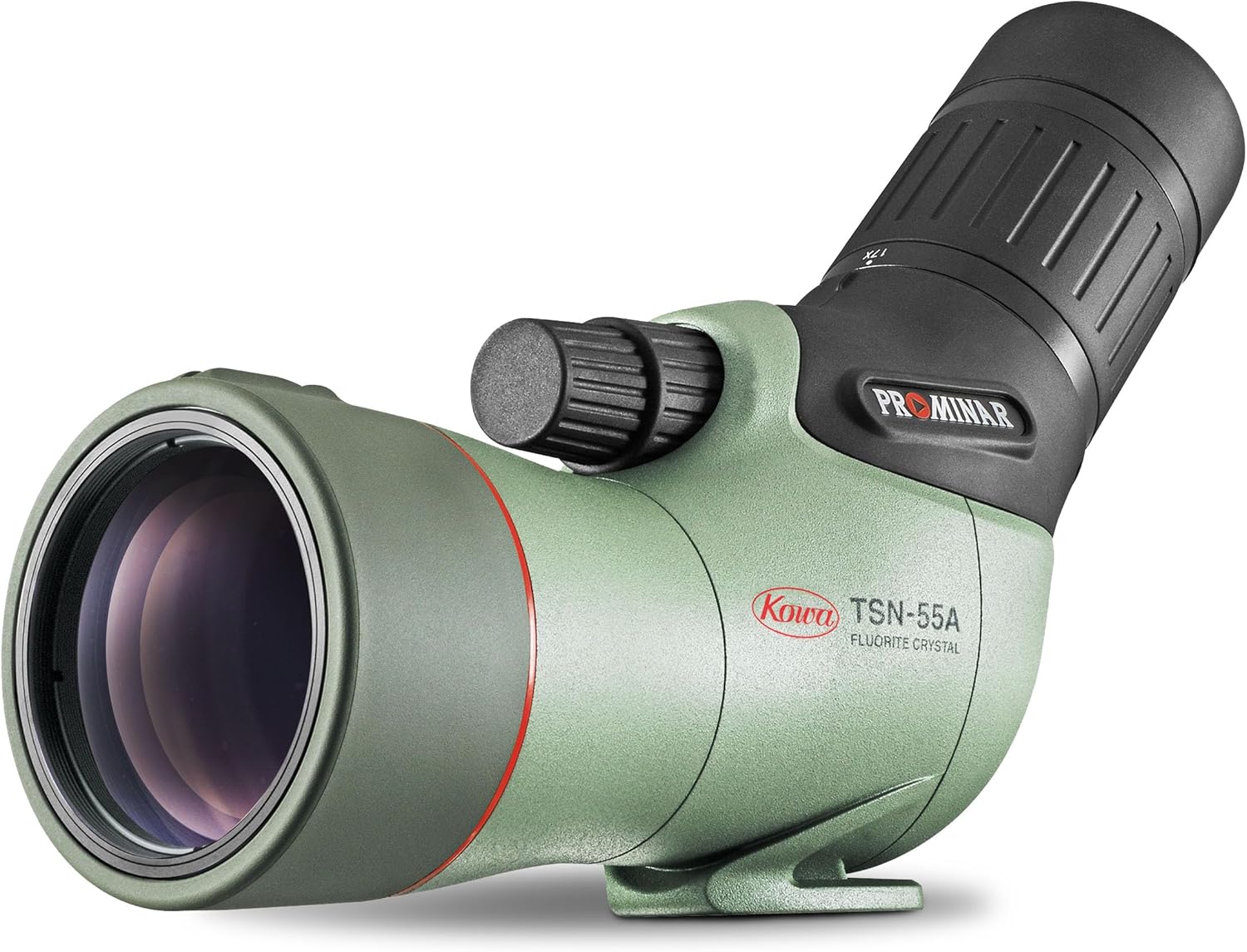
If you travel internationally to bird — and weight in your pack is a genuine constraint — the 55mm class exists for you. The TSN-554 at 600g is less than half the weight of the Vortex Razor HD and fits in carry-on luggage alongside a tripod head. Kowa uses pure fluorite crystal (FC) glass, not just ED elements, which delivers exceptional color accuracy in a compact body. The optical performance relative to 80mm+ scopes is limited by physics: the smaller aperture collects less light, and you will notice the difference at 60x in marginal pre-dawn conditions or inside a forest shade. For dedicated travel birders working from a checklist in good daylight on a trip to Costa Rica or Kenya, this scope addresses the real constraint — the 80mm scope back home doesn't, because it's not with you.
- +600g body — significantly lighter than 80mm scopes; fits in carry-on with room to spare
- +Pure fluorite crystal glass — unusual at this size class; colors are genuinely exceptional for 55mm
- +Modular eyepiece system — interchangeable with Kowa TSN-80 if you upgrade later
- +Nitrogen purged — reliable in coastal and tropical humid conditions
- −55mm aperture gathers less light than 80–85mm — visible at high magnification in low light
- −Requires purchase of a compatible zoom eyepiece separately — factor that into the total cost
- −5-year warranty is weaker than Vortex lifetime coverage
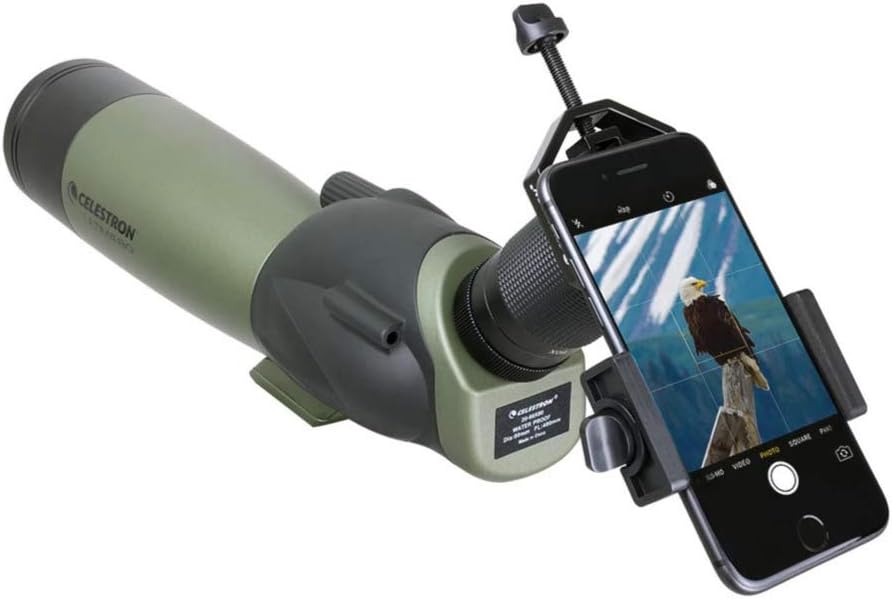
The Ultima 80 is included because some readers need a spotting scope under $200 and it is the best available at that price — with honest caveats. It is not waterproof, which limits use in rain or sea spray. The standard multi-coated glass produces noticeably lower contrast and color accuracy than ED glass above 30x, particularly on backlit subjects. At 20x it works reasonably well for scanning a reservoir or open flood. For a beginner's first scope at a hawk watch or a reserve scope kept at a fixed window, it does the job. Don't expect the resolution of ED scopes at 50–60x; the image softens beyond 40x. A solid tripod matters at this price range — the scope will expose every wobble from a flimsy setup.
- +Under $200 with an 80mm aperture — the largest objective at this budget
- +Zoom eyepiece included — no additional cost to get operational
- +Angled configuration is the right choice for birding from eye level or sitting
- +Lightweight relative to 80mm ED scopes — easier to carry without a heavy tripod
- −Not waterproof — a single wet session can cause permanent internal fogging
- −Standard glass degrades noticeably above 40x — limited identification ability at distance
- −2-year limited warranty
Frequently Asked Questions
Know what you need? Find where to use it.
Our trip planner matches spotting scope habitat — mudflats, reservoirs, hawk watch ridges — to regions, species targets, and seasonal timing.