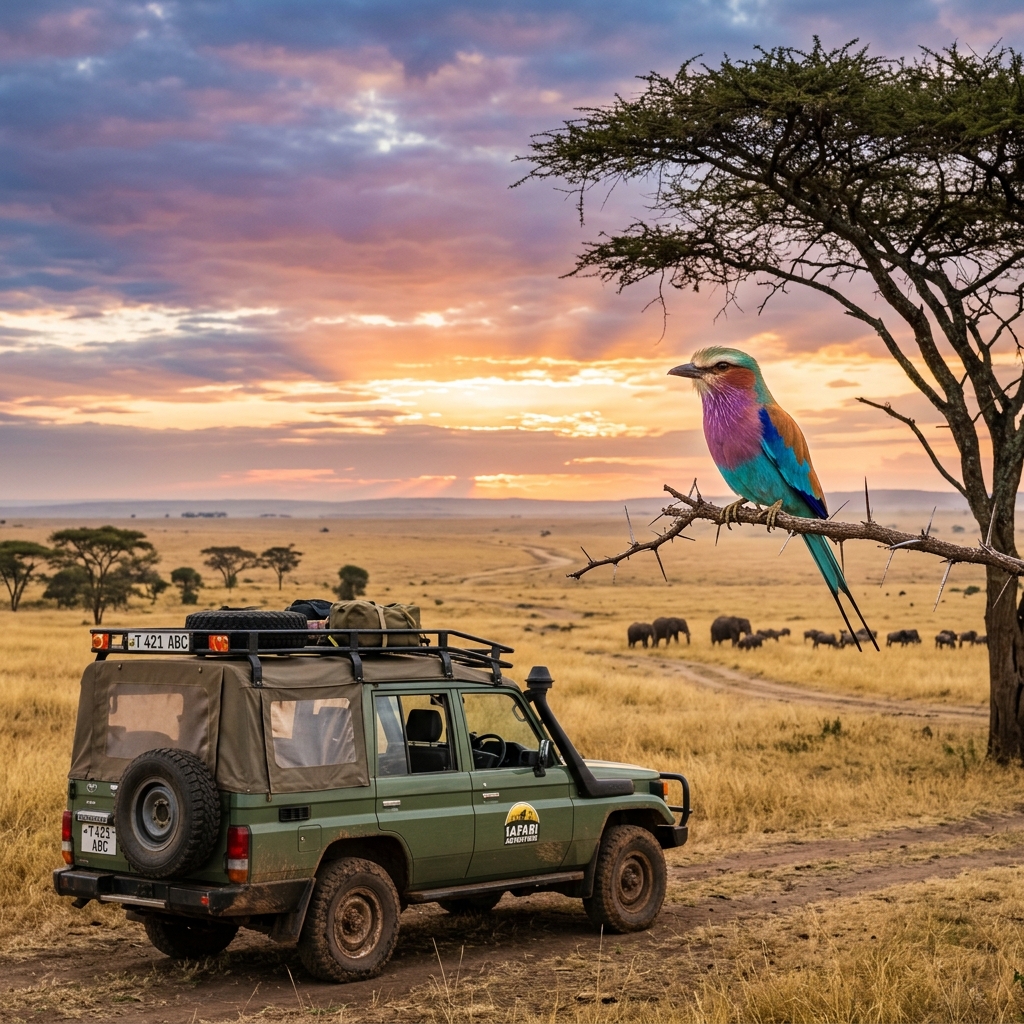
Why Tanzania for Birding
Tanzania ranks among Africa's top three birding countries with over 1,100 recorded species. What makes it unique is the combination of spectacular megafauna (the Great Migration, massive predator concentrations) with world-class birding. A Tanzania safari delivers both — lions and lilac-breasted rollers, elephants and Fischer's Lovebirds.
Top Birding Destinations
Serengeti National Park
The iconic savannah delivers excellent open-country birding:
- Secretary Bird: Tall, elegant, and often seen striding through grass
- Kori Bustard: Africa's heaviest flying bird; common on the plains
- Lilac-breasted Roller: The "national bird" of birdwatching — impossibly colorful
- Rufous-tailed Weaver: Serengeti endemic; found nowhere else
- Martial Eagle: Africa's most powerful eagle; occasional sightings
- Grey-breasted Spurfowl: Serengeti/Ngorongoro endemic
Ngorongoro Crater
The world's largest unbroken caldera (19 km wide) concentrates game and birds:
- Greater Flamingo: Thousands on the crater's soda lake
- Augur Buzzard: Soars along the crater rim
- Rosy-breasted Longclaw: Grasslands within the crater
- Hildebrandt's Francolin: Crater rim scrubland
- Verreaux's Eagle: Breeds on the crater walls
Tarangire National Park
Underrated for birding, Tarangire's baobab woodlands are outstanding:
- Yellow-collared Lovebird: Near-endemic; noisy flocks in baobabs
- Ashy Starling: Tanzania near-endemic
- Von der Decken's Hornbill: Striking black-and-white species
- Northern Pied Babbler: Social groups in woodland understory
- Breeding colonies: Massive mixed colonies of weavers, queleas, and bishops at Silale Swamp
Eastern Arc Mountains (Usambara, Uluguru, Udzungwa)
These ancient mountains harbor Africa's most concentrated endemism:
- Usambara Eagle-Owl: Range-restricted; heard more than seen
- Dappled Mountain Robin: Endemic to the Eastern Arc
- Udzungwa Forest Partridge: Discovered in 1991; one of Africa's rarest birds
- Mrs. Moreau's Warbler: Critically endangered; Uluguru Mountains only
- Iringa Akalat: Discovered in 2000; Tanzania's newest endemic
Recommended Itinerary (10 Days)
| Day | Location | Bird Highlights |
|---|---|---|
| 1 | Arrive Arusha | Hartlaub's Turaco, Silvery-cheeked Hornbill |
| 2-3 | Tarangire NP | Lovebirds, starlings, hornbills, swamp colonies |
| 4-5 | Ngorongoro | Crater flamingos, raptors, highland endemics |
| 6-7 | Serengeti | Plains game birds, Secretary Bird, Rufous-tailed Weaver |
| 8 | Lake Manyara | Flamingos, pelicans, African Fish Eagle |
| 9-10 | West Usambara | Eastern Arc endemics, mountain forest specialists |
Best Season
- Dry season (June – October): Best for game viewing and photography. Vegetation is sparse, making birds easier to spot.
- Green season (November – May): Migratory species present. Breeding plumage. More challenging but rewarding for dedicated birders.
- Best compromise: June – July or November – December
Practical Tips
- Combine with mammals. Every game drive is simultaneously a bird drive. Ask your guide to stop for birds too.
- Budget: $250–$500/day for all-inclusive safari (vehicle, guide, parks, accommodation)
- Binoculars are essential. Most safari companies provide them, but bring your own quality pair.
- Eastern Arc requires separate planning. These mountains are off the standard safari circuit. Budget 2-3 extra days and use specialist birding guides.
Find your perfect birding location next
Use our smart planner to discover the best spots matched to your experience level and the birds you want to see.