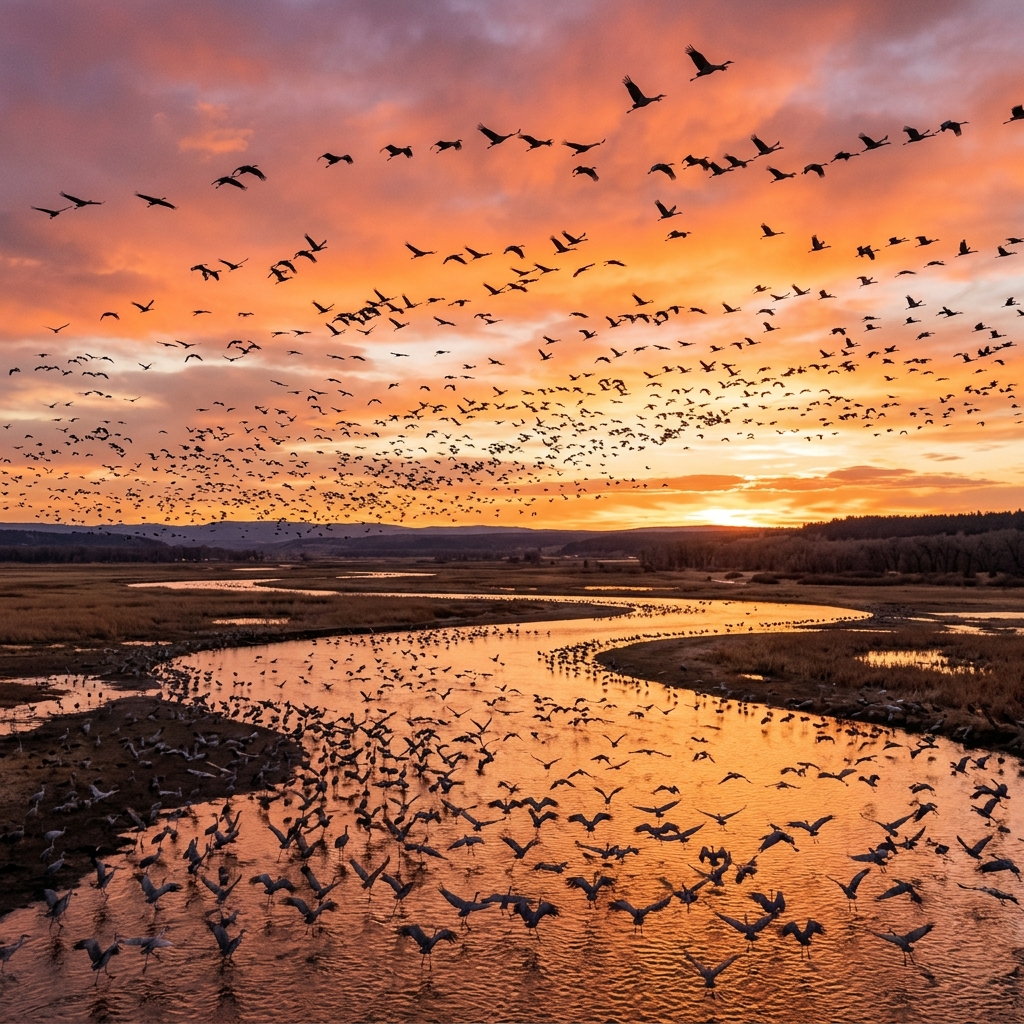
The Scale of Bird Migration
Every year, an estimated 50 billion birds undertake seasonal migrations across the planet. Some journeys are modest — a few hundred kilometers between elevations. Others are staggering: the Arctic Tern flies 71,000 km annually, from Arctic breeding grounds to Antarctic seas and back.
Migration is driven by the simple economics of food and daylight. As days shorten in temperate and polar regions, insects, seeds, and fruit become scarce. Birds move toward the equator to survive winter, then return to higher latitudes where long summer days provide more foraging hours for raising young.
The Four Major Flyways (Americas)
In the Americas, birds funnel along four primary north-south corridors:
1. Atlantic Flyway
- Route: Arctic Canada → Eastern Seaboard → Caribbean → South America
- Key bottleneck: Cape May, New Jersey — 100,000+ raptors in October
- Peak species: Blackpoll Warbler, Red Knot, Peregrine Falcon
- Best months: April-May (north), September-November (south)
2. Mississippi Flyway
- Route: Central Canada → Mississippi River Valley → Gulf of Mexico → Central America
- Key bottleneck: High Island, Texas — legendary warbler fallouts in spring
- Peak species: Scarlet Tanager, Indigo Bunting, American Redstart
- Best months: April-May (north), August-October (south)
3. Central Flyway
- Route: Alaska/Central Canada → Great Plains → Mexico
- Key bottleneck: Platte River, Nebraska — 600,000 Sandhill Cranes in March
- Peak species: Sandhill Crane, Swainson's Hawk, Upland Sandpiper
- Best months: March-April (north), September-October (south)
4. Pacific Flyway
- Route: Alaska → Pacific Coast → Mexico → Central America
- Key bottleneck: Malheur NWR, Oregon and Salton Sea, California
- Peak species: Western Sandpiper, Snow Goose, Tundra Swan
- Best months: March-May (north), August-November (south)
How Birds Navigate
Migrating birds use multiple navigation systems simultaneously:
- Sun compass: Birds track the sun's position relative to the time of day
- Star compass: Nocturnal migrants orient using star patterns, particularly the North Star
- Earth's magnetic field: Magnetite crystals in the upper bill detect magnetic field lines
- Landmarks: Experienced adults follow coastlines, rivers, and mountain ranges
- Smell: Some seabirds (like shearwaters) may use olfactory maps of ocean chemistry
Peak Migration Windows by Region
| Region | Spring Peak | Fall Peak | What to Watch |
|---|---|---|---|
| Northeast US | May 5–20 | Sep 15–Oct 15 | Warblers, thrushes, vireos |
| Gulf Coast | Apr 10–25 | Sep 1–Oct 15 | Trans-Gulf migrants, raptors |
| Great Plains | Mar 15–Apr 15 | Oct 1–Nov 15 | Cranes, geese, shorebirds |
| Pacific Coast | Apr 15–May 15 | Aug 15–Oct 30 | Shorebirds, raptors, seabirds |
| Central Europe | Apr 1–May 15 | Aug 15–Oct 30 | Raptors, storks, cranes |
How to Experience Migration
Hawk Watches
The most dramatic migration spectacles occur at raptor concentration points where geography funnels thousands of hawks, eagles, and falcons past a single overlook:
- Hawk Mountain, Pennsylvania — the world's first hawk watch, active since 1934
- Veracruz, Mexico — 4-5 million raptors pass through in October
- Eilat, Israel — junction of three continents; 1.5 million raptors annually
- Batumi, Georgia — 1 million raptors each September
Warbler Fallouts
When northbound songbirds encounter storms over the Gulf of Mexico, they drop exhausted into the first available trees on the coast. The result: hundreds of warblers, tanagers, and buntings in a single acre of coastal woodland.
- High Island, Texas (April) — Boy Scout Woods and Smith Oaks
- Fort Morgan, Alabama (April) — less crowded but equally dramatic
- Magee Marsh, Ohio (May) — famous boardwalk with eye-level warblers
Crane Staging
- Platte River, Nebraska (March) — 600,000 Sandhill Cranes; one of nature's greatest spectacles
- Hortobágy, Hungary (October) — 100,000+ Common Cranes on the steppe
Find your perfect birding location next
Use our smart planner to discover the best spots matched to your experience level and the birds you want to see.